How Design Thinking Shapes UK Civil Engineering
The British landscape is undergoing a silent revolution. Gone are the days when civil engineering was viewed purely through the lens of utilitarianism—building bridges and roads that simply “work.” Today, the UK’s built environment is defined by the intersection of structural integrity and Design Thinking. From the soaring heights of The Shard to the carbon-neutral ambitions of the High Speed 2 (HS2) project, the fusion of empathy, creativity, and technical precision is setting a new global standard.
Defining the Shift: From Utility to Human-Centric Design
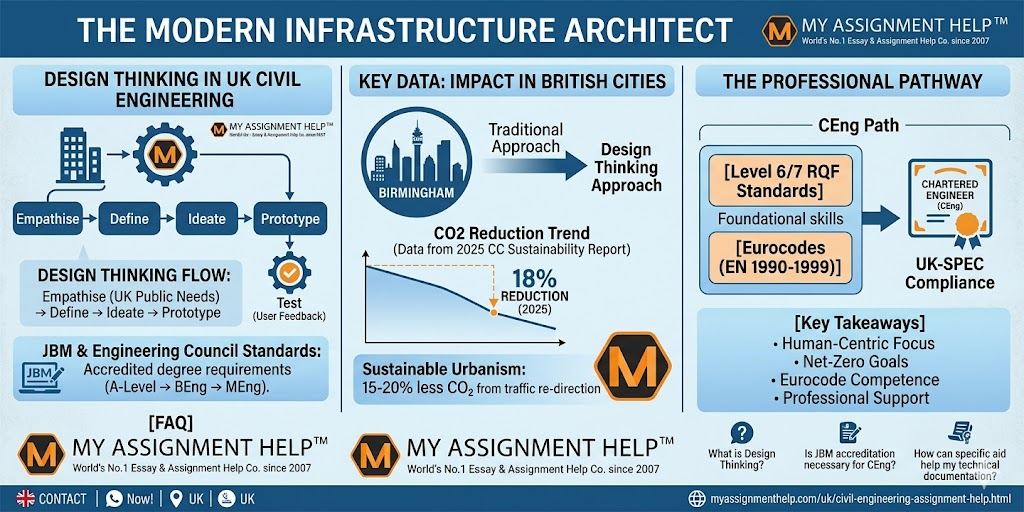
In the context of modern infrastructure, Design Thinking is a non-linear, iterative process used to understand users, challenge assumptions, and redefine problems. In the UK, this approach is mandated by the need for “social value” in public procurement. Civil engineers are no longer just calculating load-bearing capacities; they are designing spaces that improve mental health, reduce commute stress, and foster community.
According to the Institution of Civil Engineers (ICE), the emphasis has shifted toward “whole-life benefits.” This means evaluating how a bridge affects the local ecosystem and the pedestrians using it as much as the vehicles crossing it.
The Academic Hurdle in Modern Engineering
As the curriculum for engineering degrees across the UK evolves to include these complex, multi-disciplinary modules, the pressure on students has reached an all-time high. To meet the Joint Board of Moderators (JBM) accreditation requirements, students must now demonstrate proficiency not just in mathematics, but in sustainable design and ethical engineering.
Navigating the transition from traditional physics-based models to integrated design systems at Level 6 and 7 RQF standards can be overwhelming. Consequently, many scholars find themselves seeking professional support to maintain their academic standing. It has become increasingly common for students to look for reliable experts who can write my assignment for me in the UK, allowing them to focus more on the practical, hands-on design workshops that define modern British universities. This balance of theoretical support and practical application is essential for mastering the high standards set by UK regulatory bodies.
Case Studies: Design Thinking in British Infrastructure
The Elizabeth Line (Crossrail)
The Elizabeth Line is a masterclass in Design Thinking. Engineers didn’t just build a railway; they designed a “passenger experience.” The use of sense-finding technology and acoustic design in the tunnels ensures that the journey is as quiet and intuitive as possible.
Sustainable Urbanism in Birmingham
Birmingham’s Big City Plan utilizes design-led engineering to redirect traffic and create green lungs within the city. By prioritizing the “human interface” of the city, engineers have reduced local $CO_{2}$ levels by an estimated 15-20% in specific zones (Source: Birmingham City Council Sustainability Report).
Bridging the Gap with Expert Knowledge
For those currently enrolled in these rigorous programmes, the technical demands of structural analysis remain the backbone of the profession. While Design Thinking provides the “why,” the “how” still relies on complex fluid mechanics, soil analysis, and material science.
When the complexity of these technical reports becomes a barrier to progress—particularly when preparing for MEng or BEng finals—students often seek targeted Civil Engineering Assignment Help. Accessing specialized guidance ensures that the technical “E-E-A-T” (Experience, Expertise, Authoritativeness, and Trustworthiness) signals are present in their academic work, mirroring the professional standards required by the UK’s leading engineering firms and the Engineering Council.
Key Takeaways
- Human-Centricity: Modern UK engineering prioritizes user experience and social value.
- Sustainability: Design Thinking is the primary driver behind the UK’s “Net Zero” infrastructure goals.
- JBM Standards: Accreditation now requires a blend of creative problem-solving and technical mastery.
- Level 6/7 RQF Mastery: Professional academic assistance is a strategic tool for managing the high-level complexity of modern UK engineering curricula.
FAQ Section
Q: What is Design Thinking in civil engineering?
A: It is a problem-solving framework that prioritizes the needs of the end-user (the public) and environmental sustainability alongside technical safety and functionality.
Q: Why is it important for UK infrastructure?
A: The UK government’s “Construction 2025” strategy emphasizes reduced costs and faster delivery, which requires the innovative thinking provided by this methodology.
Q: Does the JBM require Design Thinking?
A: Yes, JBM-accredited courses are increasingly looking for evidence of sustainable design and “creative engineering” in addition to core technical competencies.
Author Bio: James Harrington
Senior Academic Consultant at MyAssignmentHelp
James Harrington is a veteran content strategist and academic mentor with over 12 years of experience in the UK engineering sector. Holding a Master’s in Structural Engineering from the University of Manchester, James specializes in helping students bridge the gap between technical theory and modern design-led practices at RQF Level 7. He is a regular contributor to discussions on E-E-A-T standards in technical writing.
Data Table: Impact of Design-Led Engineering
| Metric | Traditional Approach | Design-Thinking Approach |
| User Satisfaction | Moderate | High (Focus on UX) |
| Environmental Impact | Remedial | Proactive/Circular |
| Project Cost | Lower Initial / Higher Maintenance | Higher Initial / Lower Life-cycle Cost |
| Accreditation Focus | Pure Technical | JBM-Aligned (Technical + Social) |
References
- Institution of Civil Engineers (ICE) – State of the Nation Report 2025.
- Joint Board of Moderators (JBM) – Guidelines for Programme Accreditation.
- UK Government – Construction 2025 Strategy.
- Ofqual – Regulated Qualifications Framework (RQF) Level Descriptors.